Obsidian × Claude CodeCodex
The 30-Day Agentic Second Brain
A personal AI system for context, decisions, routines, and tools.
Message on WhatsApp

Build the AI second brainBecome

2,100 hours of building the personal AI system I wish I had from day one.

Your context is the moat.

This isn't about coding. The people pulling ahead have turned their own notes, decisions, and context into fuel an agent can run on, while everyone else still starts from a blank chat.

"I spend much of my day working with an AI collaborator that intimately knows my business, my values, my writing style, and my current projects."
Tiago ForteTiago ForteCreator, Building a Second Brain

The question is not whether to build this muscle. It is whether you build it now, or scramble to catch up later.

Which one sounds like you?

The Prompter

Starts from zero every time

  • Re-explains the same context to a blank chat, every time
  • Notes scattered across ten apps, nothing queryable
  • Copies prompts from YouTube and hopes for the best
  • AI feels generic because it doesn't know anything about you
  • Falls behind every time the tools change
The Operator · this is where you want to be

Runs on their own context

  • A personal AI that already knows their projects, decisions, and history
  • One vault as the single source of truth, everything in one place and queryable
  • Agents that run their daily workflows on their own context
  • Memory that persists across sessions, so they never re-explain
  • Spends time deciding, not copy-pasting context between windows
  • Owns the files. Plain text on their computer, not on someone else's cloud

Built for people who manage complex context for a living.

Professionals in demanding roles

Architects, engineers, consultants, marketers, COOs. You manage complex information for a living, but your own context lives in a dozen tabs. AI should be your biggest leverage point, not one more tool you never set up properly.

Entrepreneurs and creators

Content creators, coaches, startup founders. You need systems to produce, but the system building keeps eating into your production time. You want AI that works with your creative process, not one that adds another layer of complexity to it.

Career changers and lifelong learners

You are reinventing yourself or stepping into something new, and the digital skills gap feels real. You do not need another beginner tutorial. You need a framework that meets you where you are and makes your experience an asset, not a liability.

Neurodivergent thinkers

If you have ADHD or simply think differently, a messy setup costs you more. The promise of AI is real for you, maybe even more than for most, but only if the system reduces friction instead of adding it. This program is built around structure that works with how your brain operates.

This is probably not for you if
  • You have never used an AI tool and want a beginner overview of how they work
  • You have plenty of free time to self study and you are happy with your progress
  • You want fully autonomous agents that replace human judgment
  • You are a developer building AI products. This is for knowledge workers using AI, not building it

Tools change every month. These skills compound forever.

01

Aligning

Shared understanding

Refusing to execute blindly. Forcing the agent to relentlessly interview you and pressure-test your assumptions until you reach a bulletproof "shared understanding" before any work begins.

02

Planning

Verification loops

Resisting the urge to prioritize speed over quality. Building highly specific plans with strict "verification steps" so the AI is forced to check its own work and cannot fake progress.

03

Supervising

Refusing mediocrity

Rejecting the urge to blindly delegate and accept generic AI "slop". Meticulously verifying the agent's logic and pushing back on bad assumptions, treating your rigorous human standard as your ultimate competitive moat.

04

Evolving

Anti-perfectionism

Avoiding the trap of designing a "perfect system from scratch" with rigid folder structures. Starting incredibly small and letting your playbooks emerge from your actual daily behavior.

05

Managing context

The dumb zone

Building the intuition to track your token budget, knowing exactly when the agent hits the threshold where it starts "cutting corners" and making bad decisions.

06

Reflecting

The retrospective

Never just closing a finished chat. Mining your daily conversations for friction and feeding those learnings back in, so your agent gets permanently smarter every week.

Who teaches this.

Artem Zhutov
Artem Zhutov, PhD
Instructor · Obsidian × Claude Code Lab

I ship Obsidian and Claude Code systems to production. I am a lead AI engineer at a 50 person startup, and for the past two years I have built second brains with Claude Code and published the most in depth content on it on YouTube.

This course is 2,100 hours of that work condensed into one playbook. My teaching comes from a physics PhD at the University of Waterloo and first principles thinking. I pair every concept with the problem it solves, so you build real intuition for a fast moving tool instead of copying prompts.

Artem Zhutov

Everything you would eventually learn, without the wasted hours.

Piecing it together alone

The slow road

  • 500+ hours across docs, YouTube, and trial and error
  • Content goes stale as features ship
  • You don't know what you don't know
  • No way to know if you are doing it right
  • No one to ask when you get stuck, you learn alone
This course · the shortcut

30 days, start to finish

  • A structured path from two years of building second brains
  • Updated as the tools ship
  • Patterns from real production work, not shiny demos that show nothing real
  • The starter vault, proven building second brains with 50+ people
  • Private community access
"People who aren't keeping up even over the last 30 days already have a deprecated worldview on this topic."
Andrej KarpathyAndrej Karpathy · Co founder, OpenAI

This course stays current.

Last updated
This week
Modules
11
Total lessons
65

Build Your Personal AI System

Eleven modules to give AI your context, build the system around your work, grow a digital workforce, and turn your thinking into tools people use.

1

Chapter 1 · Give AI Your Context

Module 1 · 8 lessons

Build an AI that knows you.

Turn your notes, decisions, and priorities into context your AI can use.

Module 2 · 13 lessons

Your first autonomous agent.

Build an agent for a real job, teach it how you work, and put it on a routine.

Module 3 · 7 lessons

Your personal memory system.

Give every session the context it needs without re-explaining yourself.

2

Chapter 2 · Build the System Around You

Module 4 · 4 lessons

Give your AI access to your world.

Turn 200 email threads into a morning decision brief, then wire in any service through MCP or API.

Module 5 · 5 lessons

Build your Life OS dashboard.

One live view of what matters, what is moving, and what needs your attention.

Module 6 · 8 lessons

Your AI work operating system.

Plan, review, execute, and resume work without losing context or re-explaining the standards.

3

Chapter 3 · Grow Your Leverage

Module 7 · 4 lessons

A second brain that learns from your work.

Every correction becomes better work the next time.

Module 8 · 2 lessons

Grow your digital workforce.

Automate any website action, even if there is no API; record once, reuse forever.

Module 9 · 2 lessons

Work that runs without you.

Build routines for publishing, research, reporting, and follow-ups that keep moving without your attention.

4

Chapter 4 · Turn Knowledge Into Useful Output

Module 10 · 4 lessons

Your personal research department.

Ingest 300 podcast episodes and leave with a playbook you can run; turn a book into a skill and audit your own work with it.

Module 11 · 8 lessons

Turn your thinking into tools people use.

From private notes to live tools, dashboards, and pages.

They built it. Then they told people.

Operators from
Oracle DBS Bank University College London Office for National Statistics Pratt Institute
Microsoft Atlassian Lazard
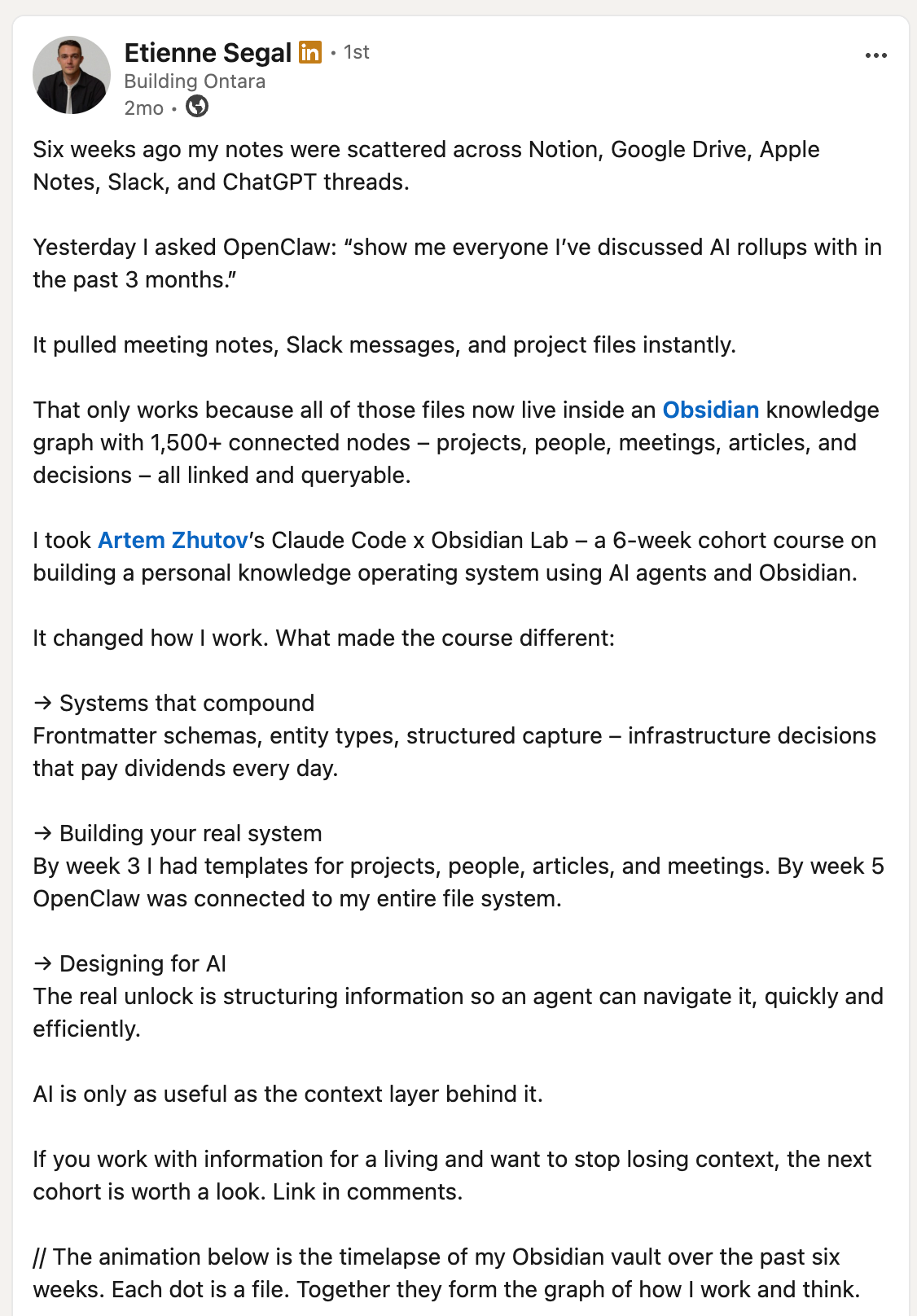
LinkedIn post by Etienne Segal (Building Ontara) about Artem Zhutov's Claude Code x Obsidian Lab
“It changed how I work.

Six weeks in, 1,500+ connected nodes. AI is only as useful as the context layer behind it — and the course is how you build that layer.

Get instant access to the full playbook.

Everything you need to master Claude Code and Obsidian, distilled into the exact system I wish I had on day one.

What's included
Agentic Second Brain · the full playbook
  • The starter vault, pre-built $297 value
    Structure, templates, frontmatter conventions, dashboards. You open it and it already works; the agent knows where everything belongs.
  • 25 pre-built skills $497 value
    Project manager, daily morning review, weekly review, retrospective, grill-me, session-intelligence, NotebookLM, presentations, safe deploy, and 16 more. Every skill demoed live in the lessons.
  • The full playbook: 65 lessons across 11 modules
    Practical and hands on, foundations through advanced. No filler.
  • Lab Wiki + NotebookLM workspace $694 value
    The full curriculum as a searchable wiki, plus a NotebookLM workspace you can ask what to learn next.
  • Private community + monthly office hours $394 value
    A private community of people building on their own context, plus a live office-hours session each month, capped at 30 seats.
  • Updated as the tools ship
    Last updated this week. New lessons land as features change, so it never goes stale.
  • Lifetime access
    Buy once, keep it. Self paced, every future update included.
$1,882 in stand-alone value, plus the playbook itself. Today: $790.
Your first week
DAY 1
Your AI knows your work.Your personal vault holds the context it needs.
DAY 3
Your first autonomous agent runs.Build it for a real job and put it on a routine.
DAY 7
Your morning review runs on your context.Start with decisions, priorities, and signals in one view.
$790
One-time payment · Lifetime access
500+ hours across docs, YouTube, and trial and error. Or $790.
The Week-One Guarantee. If you don't have your first agent running by the end of week one, full refund. No questions.
WhatsApp·Invoice
Self paced. Lifetime access and every future update included.

Questions, answered.

Do I need to know how to code? +
No. This is built for knowledge workers, not engineers. You will use Claude Code, but the course teaches you to direct it in plain language. You describe what you want, the agent does the building.
Can I use Codex or another AI provider? +
Yes. We are building a system that works with any AI provider. Your second brain is plain markdown on your computer, and your setup lives in AGENTS.md, the platform-agnostic file that Claude Code, Codex, or any future agent can read. The course teaches with Claude Code and covers the agent landscape, including Codex, in Module 2.
Do I have to use a coding terminal? I prefer a clean interface. +
You don't have to live in the terminal. We use the Claude Code desktop app, which gives you the exact same capabilities but with a clean, conversational interface you are already used to.
I am already deep in Obsidian. Is this for me? +
Yes, and you are ahead. If you already have a vault, we connect Claude Code to the notes you already have, so your existing context becomes the thing your AI runs on.
My vault is a massive mess of unstructured notes. Do I need to clean it up first? +
No, your existing messy vault is the perfect starting point. The course teaches you how to deploy the agent to autonomously triage your inbox, fix your frontmatter, and organize the chaos for you.
I have multiple Obsidian vaults for work and personal life. Do I need to merge them? +
No. You will learn how to use symlinks to mount external projects, so you orchestrate all your separate vaults from one central command center without ever mixing your private data.
Will running these agents cost me hundreds of dollars in API fees? +
No, you only need the standard Claude subscription. We teach you to be fiercely token-efficient by querying local, structured metadata (like frontmatter and dynamic tables) instead of burning tokens forcing the AI to blindly read thousands of raw text files.
Is it safe? Will the agent accidentally delete my vault or mess up my files? +
We do not take risks with your data. You will set up automatic GitHub backups and strict guardrails — like avoiding the dangerously-skip-permissions flag — so the agent behaves predictably and never modifies files without your permission.
I'm on a Windows machine for work. Will this still work for me? +
Yes, Claude Code runs perfectly on Windows, macOS, and Linux. The course defaults to the Claude Code desktop app and includes platform-specific troubleshooting, so you can bypass setup errors and start executing immediately.
How much time per week does it take? +
A few focused hours a week is enough to keep pace. It is self paced, so you can move faster or slower, and you keep lifetime access either way.
What if I fall behind? +
You can't, really. It is self paced with lifetime access and ongoing updates, so you can pick it back up whenever you want and you will always have the latest version.